I believed something a lot of operators are taught early on: If you can communicate your ideas clearly enough, they’ll land.
Early in my career I obsessed over slides. Over narratives. Over getting every word exactly right. And still—great ideas stalled. Not because the ideas weren’t strong. But because no one could experience them.
That was the unlock for me: Clarity of thought matters more than clarity of words—and the fastest way to show clarity is to build.
The Operator’s Dilemma
If you work in GTM, you’ve lived this cycle:
Idea → Slides → Meeting → Revisions → More meetings → Hand-off to developers → Months later… Maybe something ships.
By the time anything becomes real, the moment has passed. The business has moved on. Or worse—the idea gets diluted beyond recognition.
Here’s the core problem: Leadership can’t give meaningful feedback on something they can’t interact with.
Slides are static. Ideas are abstract. Execution feels far away.
So even strong ideas struggle to gain traction. Clear writing does matter—but today, it’s table stakes.
Clarity of thought doesn’t come from polishing your message. It comes from pressure-testing your idea with purpose, usability and plausibility.
“Show, Don’t Tell” Isn’t Just for Storytelling
Operators have an advantage right now:
- We’re closest to the business.
- We understand the pain points.
- We talk to customers and stakeholders every day.
And now—with AI—we can build.
- You don’t need to wait for engineering.
- You don’t need a perfect spec.
- You don’t need permission.
You need curiosity—and a willingness to try. The fastest way to move an idea forward is to show it.
When someone can click, explore, and react in real time, everything changes. Feedback gets sharper. Decisions get faster. And suddenly, you’re not just presenting an idea—you’re leading it.
Where Do You Start?
This is the question I hear most: “With so many possibilities, what should I build?”
Start smaller than you think. Look at your day-to-day work.
Marketing teams might explore event registration flows, partner communications, or performance dashboards. Sales teams might look at proposal workflows, ROI calculators, or internal enablement tools. Repeatable, high-traffic, high-touch interactions or requirements for team members.
The goal isn’t a big, groundbreaking idea. It’s solving a real, persistent problem.
I use a simple framework to guide this type of decisioning: PTO.
P: Pain point
Is there a clear, tangible problem? Can you point to where it shows up?
T: Time wasted
Is this costing time or money—and is it recurring?
O: Openness to change
Will people actually use a new solution? Are they already asking for something better?
If it passes that test, it’s worth building.
Why This Changes Your Career Trajectory
When you shift from “idea person” to “builder,” three things happen:
- You become indispensable
You’re not just identifying problems—you’re shipping solutions. - You gain visibility where it matters
Working prototypes get you into the rooms where decisions are made—not because you asked, but because your work demands it. - You become AI-native
Every tool you try and every experiment you run compounds. What felt impossible six months ago becomes second nature.
Women are often told to refine, polish, and perfect before presenting. But in this environment, speed and curiosity win. Your willingness to try is your competitive advantage.
An Important Shift
One of the most powerful shifts I made with AI was treating it like a thought partner—not a search engine.
Ask it to challenge your thinking. To explore options. To pressure-test your ideas. For example, I may say, “I want you to be a thought partner with me on this; help me explore ideas.” AI is changing, expanding and learning all the time so make it think with you, not just for you.
Your ideas are probably stronger than your communication. But communication alone isn’t what moves ideas forward anymore. Building does.
Show your partners, stakeholders and leaders the wrapping paper first. Give them something they can touch, react to, and believe in. Then build from there.
Join me at https://ai-recess.com/ for a judgment-free playground where teams can experiment, learn, and grow together.
———————————————
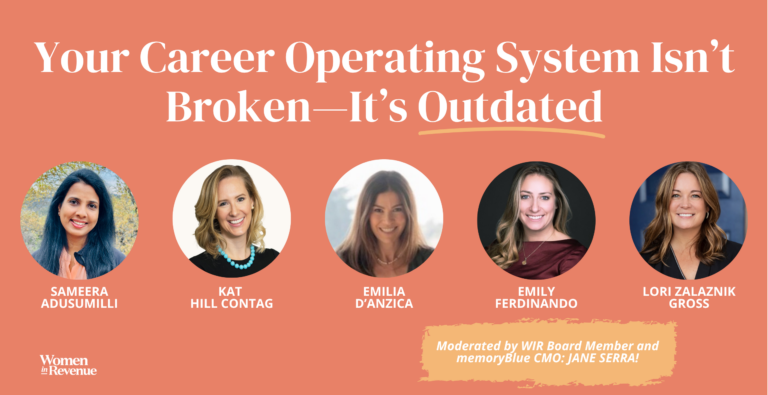
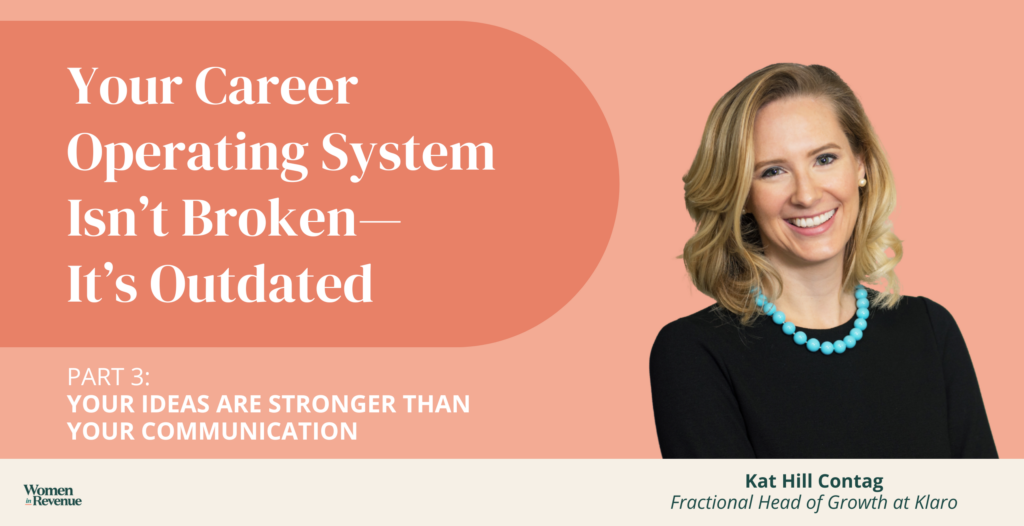
Kat Hill Contag’s presentation on Your Ideas are Stronger than Your Communication, was part of the Women in Revenue members-only Mini-Series: Your Career Operating System Isn’t Broken—It’s Outdated.
Kat Hill Contag is a GTM consultant and 3x founder who discovered that building prototypes gets more executive buy-in than perfect pitch decks ever did. A winner of Lovable’s SheBuilds hackathon, she now teaches women how to build with AI through her platform AI-Recess.com and monthly study sessions with Minneapolis Women in AI, on a mission to help more women operators advance their careers by becoming builders. Connect with Kat at kathillcontag.com
To gain access to all Women in Revenue events and resources sign up to be a member here.