As a go-to-market (GTM) leader you probably know more about AI than you actually use. And you’re not alone.
Most of the women leaders I work with tell me the same thing: “I know AI matters, I’m reading about it everywhere, but I still feel overwhelmed about where to start.”
I see this across organizations and teams of every size. The biggest roadblock for GTM leaders isn’t lack of skills or the curiosity to learn. It’s most often the pressure of the day-to-day. When you’re running a team, chasing targets, fighting for resources, or trying to get accurate forecasts, AI experimentation can feel like something else you’ll “get to later” versus the way to “get there sooner.”
Here’s the truth I want every leader to internalize:
You do not need a fully orchestrated AI strategy to start making progress. You only need one small, meaningful use case. One thing that saves your reps time. One thing that improves accuracy. One thing that gives you a clearer picture of your business.
Let’s break down three areas where AI is ready to transform prediction for GTM teams: deal forecasting, win analysis, and churn prevention. Each one of these can become easier and more accurate once you start leveraging AI to feed your systems better data.
1. Better Prediction Starts With Better Data
Here’s the hard reality of forecasting: Most data in a CRM is wrong.
Not because reps are lazy. Because humans are human. We forget. We fall behind. We make assumptions. We apply our own bias to how we categorize deal stages, forecast calls, or qualification criteria.
As a result, leaders spend hours every week cleaning, validating, and second-guessing the data that’s supposed to be helping them make decisions.
That’s the first problem AI can solve. By automatically collecting data from call recordings, meeting transcripts, emails, signals, and interactions – time, error and biases are removed, and your CRM quickly transforms from just a system of record to a system of action.
Tools like Momentum, Gong, Attention, or your own in-house AI agents can automatically capture pertinent customer data and information like stage analysis, stakeholders, buying signals, risks or objectives and competitive mentions.
This automation removes human bias and replaces guesswork with facts. Your forecasting process doesn’t have to change, but you can very quickly run it with better, more complete data.
Imagine forecasting when:
- You know whether a deal is truly in the right stage.
- You know if the economic buyer was actually in the meeting.
- You know if qualification criteria were met instead of trusting a checkbox.
- You know if reps are running the steps correlated with closed-won.
This isn’t about replacing human judgment. It’s about supporting it. When technology can help collect the data, humans can focus on the decisions.
2. Use AI to Understand Why You Win—and Replicate It
One of the biggest questions for GTM leaders has always been: Why are we really winning and losing deals?
We think we know. We think we hear trends. We trust our intuition. But, AI lets us verify those instincts and uncover what’s actually predictable.
Here’s one of my favorite examples:
Rally analyzed all the Gong calls from 30 closed won deals. Then they prompted AI to summarize each one:
- What was the company profile?
- What pain points were mentioned?
- What happened in the initial outreach?
- Which competitors were involved?
- What drove the final decision?
- What did the buying committee say—verbatim?
Then, they fed all 30 summaries into ChatGPT and asked: “What are the consistent patterns that made these deals successful?”
The findings were the kind of insights that change a sales process. They learned important indicators – like if the decision maker was on the demo call and if the demo was scheduled within a specific number of days of discovery – the deal had a much higher percentage of closing.
AI didn’t just list trends—it identified predictive actions.
From there, the team also took those indicators and ran them across their active pipeline. ChatGPT scored each opportunity with a win-likelihood percentage based on how many success signals it met.
That is real-time, data-backed clarity.
Once you understand why you win you unlock a trove of opportunities to improve your forecast and business processes. You can coach to those behaviors. You can design your sales process around them. You can optimize your onboarding. You turn tribal knowledge into a repeatable motion.
This is where AI shifts from interesting to transformational. It helps your team learn from itself—and then execute better.
3. Use AI to Predict and Prevent Churn Before It Happens
Every GTM leader wants predictable growth, but churn is the biggest silent killer of predictability.
The challenge is that most traditional health scoring models are built on incomplete data, subjective inputs, and inconsistent signals. Customer success teams often rely on “gut feelings” from calls, CSM notes, or the occasional red flag.
AI can help change the game here—predicting churn earlier and with more accuracy—in the same way it does for sales.
Models like those from QuadSci use contextual analysis across CRM data (already optimized above), CSP data, call recordings, email sentiment, product usage, executive engagement and renewal timelines.
Instead of a human entering a health score manually, the system generates a predictive score with meaningful accuracy. In one client example, they were able to predict churn with 94% accuracy and identify expansion potential with 80% accuracy.
AI can flag the signals, identify the pattern, and trigger exactly what your team should do next. Whether that’s:
- Accelerating an executive check-in
- Running a risk playbook
- Relaunching onboarding for disengaged accounts
- Escalating a technical issue
- Involving a champion early in renewal cycles
When you combine better data with predictive intelligence, you shift from reactive customer success to proactive, preventative growth management.
Start Small. Start Now. Start With One Use Case.
If you take one thing from this article, let it be this: You don’t have to boil the ocean. You just have to start.
AI isn’t a massive strategy project. It’s a practical layer you can add to the work you’re already doing.
Here’s what I offer to every GTM leader I mentor:
- Pick one workflow that slows you or your team down.
- Automate the data collection.
- Ask AI to analyze the patterns.
- Apply one insight into your process.
- Repeat.
Small improvements, consistently applied, turn into better forecasts, more wins, and healthier customers.
Women in GTM are uniquely positioned to lead the next wave of AI adoption—with clarity, empathy, and process excellence.
You already know more than you think.
_____________________________________________
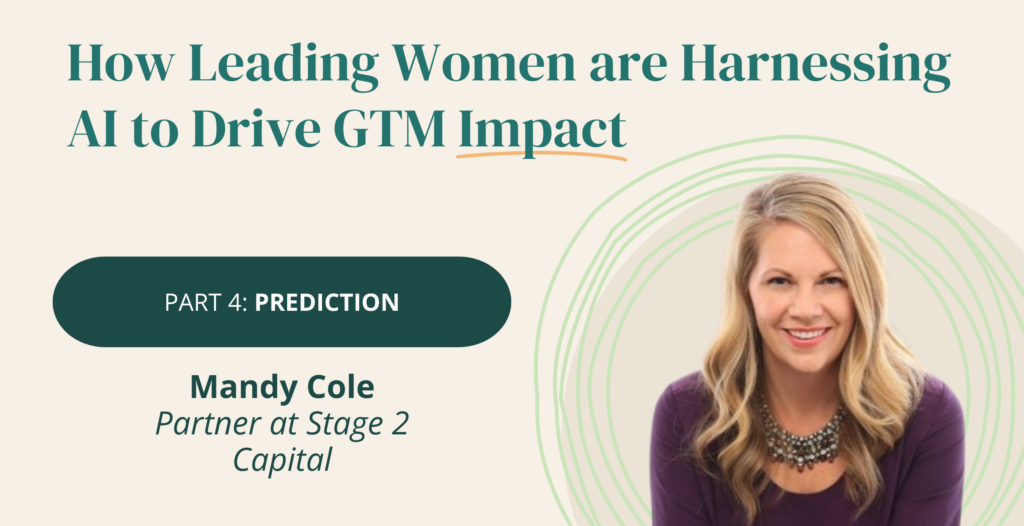
Mandy Cole’s presentation on AI and Prediction, was part of the Women in Revenue members-only Mini-Series: 4 Ways Leading Women are Harnessing AI to Drive Go-To-Market Impact.
Mandy Cole is a former GTM operator for some of the fastest-growing B2B marketplace and SaaS organizations, including LivingSocial, MyNewPlace), Main Street Hub and Zenefits. She is a founder at Stage 2 Capital, the first VC firm backed by hundreds of GTM leaders. You can connect with Mandy at mandy@stage2.capital.
To gain access to all Women in Revenue events and resources sign up to be a member here.