“You can’t build your seat at the table if you’re carrying everyone else’s chair.”
I’ve seen this play out repeatedly across my career in go-to-market and systems leadership. Many women in revenue-generating roles say “yes” more often than their male peers—not because they lack judgment, but because they value relationships, collaboration, and outcomes.
But here’s what I’ve learned: controlling scope isn’t about saying no—it’s about making sure the right things happen at the right time, with the right people in the room. And for women in leadership, especially in revenue leadership roles, scope control is one of the most powerful tools we have to drive predictable outcomes while strengthening trust.
The real issue isn’t the volume of work. It’s the surprise.
Scope Control Is a Leadership Skill—Not a Personal Boundary
Many women in leadership worry that setting boundaries will harm relationships or limit opportunity.
Common fears I hear include:
- Being labeled as rude or difficult
- Losing visibility or influence
- Damaging trusted relationships
- Missing future opportunities
But in revenue leadership, unmanaged scope isn’t kindness—it’s a risk.
When scope expands without clarity, the results are predictable:
- Burnout
- Missed deadlines
- Reactive decision-making
- Erosion of stakeholder trust
- Loss of strategic focus
Women in leadership already possess strengths that make them exceptional at managing scope—we tend to sense risk early, read the room, and build shared ownership. The move is learning to channel those instincts into structured communication — before the surprise becomes the conflict.
The Real Problem: Surprises Create Conflict
Conflict rarely happens because someone asked for work. Conflict happens when expectations aren’t aligned early.
Over the years, I’ve learned that no surprises is the single most powerful principle for controlling scope. When stakeholders don’t understand timelines, constraints, or priorities, tension builds—and tension often gets misinterpreted as resistance.
60 percent of professional women reported burnout as a primary barrier to performance, driven mainly by unrealistic workloads, blurred boundaries, and an “always-on” culture.
So when women avoid the hard conversation — they’re not being weak. They’re doing rational math based on a system that penalises women for boundaries in ways it simply doesn’t penalise men. The move isn’t to just ‘say no more.’ It’s to change the cost of no.
Your role as a leader isn’t just delivery. It’s visibility.
Six Moves to Control Scope Without Conflict
These six leadership practices help shift teams from reactive chaos to collaborative clarity.
[1] No Surprises: Communicate Before You’re Asked
Proactive communication is one of the fastest ways to build credibility.
That means:
- Sharing weekly progress updates
- Flagging risks early
- Communicating blockers immediately
- Using AI tools to consolidate and summarize updates
- Keeping stakeholders informed without waiting to be asked
When people feel informed, they feel confident—even when timelines shift.
[2] Prioritize Together, Not Alone
Scope control works best when priorities are shared, not imposed. Instead of deciding in isolation, bring stakeholders into the prioritization process.
Ask: What outcome are we optimizing for? How will those outcomes be measured?
Then with transparency for stakeholders :
- Conduct capacity check-ins
- Build transparent quarterly plans
- Align decisions to business outcomes and metrics
- Create visibility into trade-offs
In revenue leadership, alignment is everything. Shared priorities create commitment—not resistance.
[3] Lead With Data—Not Emotion
Data creates clarity. Emotion creates friction. Women in leadership are significantly more likely to be labeled “too aggressive” when negotiating—even when behaving identically to male peers. Data helps neutralize that bias.
System or AI generated tools that can help you lead with data more quickly include:
- Capacity models
- Timeline projections
- Risk forecasts
- Workload dashboards
Let the data say “no” so you don’t have to.
For example, here’s how I use Jira and Claude MCP together to show capacity and make it understandable and meaningful for all stakeholders:
Instead of saying, “I think we’re at capacity,” I can now say, “Let me check that for you.” With Jira and Claude MCP working together, within seconds, I can show exactly what’s happening:
- 47 open tasks
- 2 team members already fully booked
- A major deadline coming in two weeks
No guessing. No debating.
Once everyone sees the same real-time picture, the conversation naturally shifts from opinions to decisions. Instead of asking “Do we have room?” we start asking “What should we prioritize?”
What this replaces:
- The 5 Slack DMs asking “hey what’s the status on X?”
- The meeting that could have been a message
- The stakeholder who felt blindsided
- The conflict that started because nobody knew the project was at risk
With AI, data is a live conversation tool. You don’t need to predict the question. You just need access — and the fluency to use it in the room.
That fluency is the new boundary skill. Not assertiveness. Not confidence. The ability to say “let me show you” instead of “I believe” — and actually mean it
[4] “No” Means “Not Now”
One of the most effective reframes I teach is this: No isn’t rejection—it’s sequencing. A thoughtful “not now” protects relationships while preserving delivery quality.
When you need to defer work:
- Explain the constraint
- Provide context
- Offer a timeline
- Commit to a next step
“Not now with a path forward” is often received as a yes with a timeline—and that’s leadership.
[5] Be Proactive to Strengthen Relationships
Strong relationships aren’t built through constant availability. They’re built through reliability.
Being proactive allows you to maintain trust even when scope tightens.
Tactics that work:
- Recurring alignment meetings
- Shared dashboards and timelines
- Visible risk indicators
- Open communication channels
When stakeholders see the path forward, they stay engaged—not frustrated.
[6] Create Shared Ownership of Scope
Scope control becomes easier—and more sustainable—when ownership is shared.
Instead of carrying responsibility alone, co-create clarity.
That means:
- Documenting decisions collaboratively
- Confirming trade-offs explicitly
- Aligning on timelines and deliverables
- Reinforcing cross-functional accountability
The win isn’t protecting scope. The win is co-owning clarity. Shared ownership turns pressure into partnership.
The Cost of Avoiding Boundaries
One of the most common things I hear from women in leadership is fear of the consequences that come with setting limits. But here’s what I’ve seen repeatedly:
We are not afraid of the boundary. We are afraid of the bill that comes with it. And yet, the cost of avoiding boundaries is always higher.
Without boundaries:
- Work expands invisibly
- Timelines slip
- Trust weakens
With boundaries:
- Delivery becomes predictable
- Relationships strengthen
- Credibility grows
Leadership isn’t about saying yes to everything. It’s about ensuring the right things happen at the right time.
When women in leadership control scope with clarity and confidence, they don’t just manage work—they shape outcomes, influence strategy, and claim their seat at the table.
Difficult is what they call you before they trust you. Hold the line anyway.
———————————-
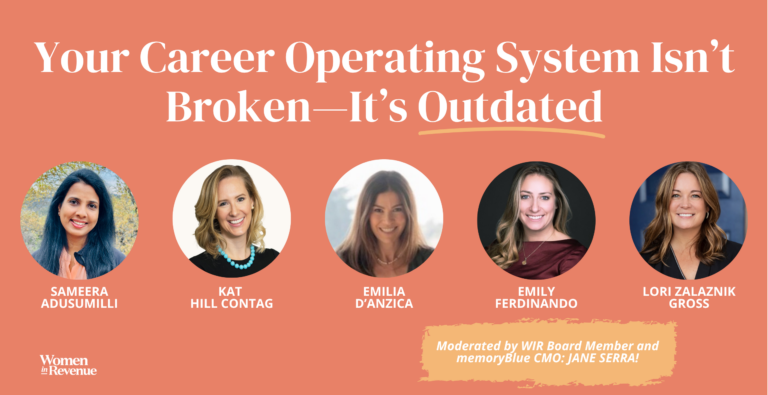
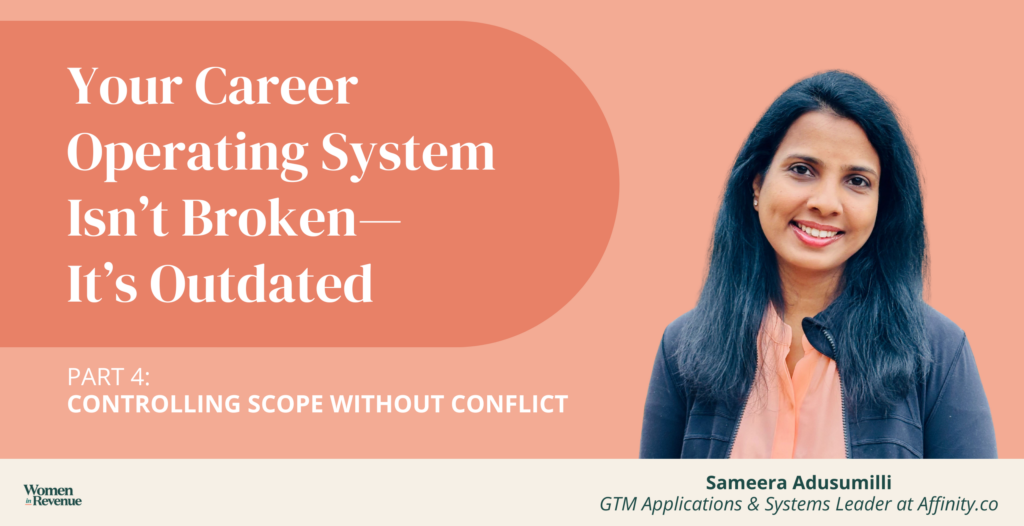
Sameera Adusumilli’s presentation on Controlling Scope without Conflict, was part of the Women in Revenue members-only Mini-Series: Your Career Operating System Isn’t Broken—It’s Outdated.
Sameera is a Go-to-Market Systems & Applications Leader with 15+ years of experience driving scalable revenue growth through systems innovation and AI enablement. She’s been at the center of some of tech’s biggest scaling moments — including Zoom’s IPO journey as the company grew from $100M to $4B ARR — and has since led GTM transformations at Birdeye, most recently joining Affinity as their GTM Applications & Systems Leader.
To gain access to all Women in Revenue events and resources sign up to be a member here.