For most of my 20-year career in Silicon Valley, I believed something many of us were taught early on: if you do great work, it will speak for itself.
It’s a comforting idea. It’s also incomplete.
If you’re a woman in a go-to-market leadership role, you’ve likely felt the gap between effort and recognition. You deliver results, build teams, drive revenue—and yet, when it comes to advancement, your impact isn’t always fully seen or acknowledged.
Data reinforces what many of us experience every day.
- 40% of women leaders say their DEI work is not acknowledged at all in performance reviews, and 37% of women leaders have had a coworker take credit for their idea. (LeanIn.org)
- Women are 14% less likely to be promoted, and that lower potential ratings explain up to 50% of the promotion gap, even though women consistently receive higher performance ratings than men. (Yale)
- Women remain underrepresented at every level of the corporate pipeline. Only 93 women are promoted to manager for every 100 men, and for women of color that number drops to 74. (McKinsey)
Fact: most decisions about your career trajectory happen when you’re not in the room.
So the question becomes: How do you make sure your work shows up when you can’t?
Visibility Isn’t Vanity—It’s Strategy
There are three myths that keep high-performing women invisible:
Myth #1: “If I do great work, I’ll get noticed.”
Great work is the entry ticket. Visibility is the strategy.
Myth #2: “Visibility means self-promotion.”
Visibility isn’t about bragging. It’s about clarity and relevance. If something matters to you, it likely matters to the business. Your job is to connect those dots.
Myth #3: “I’ll let my results speak for themselves.”
Results don’t speak. They require a translator, and that translator is you.
Anyone can build a strong slide or execute a solid plan. But the leaders who advance are the ones who can translate their work into language and influence that resonates with stakeholders and decision-makers—most likely those who never see the day-to-day execution.
Make the Right Work Visible
Visibility starts with intention. It’s not about sharing everything; it’s about sharing the right things in the right way with the right people.
Here’s what I’ve seen work well:
[1] Choose the Right Work
Not all work is created equal. Focus on the 20% that drives 80% of the outcomes.
Ask yourself:
- Does this move the company’s mission forward?
- Does it impact revenue, risk, or team growth?
- Would leadership care if this succeeded or failed?
Visibility isn’t about volume. It’s about impact.
[2] Choose the Right Frame
This is where most people fall short.
Executives don’t need operational detail—they need meaning. They think in terms of:
- Revenue growth
- Risk reduction
- Scale readiness
Your job is to translate your work into that language.
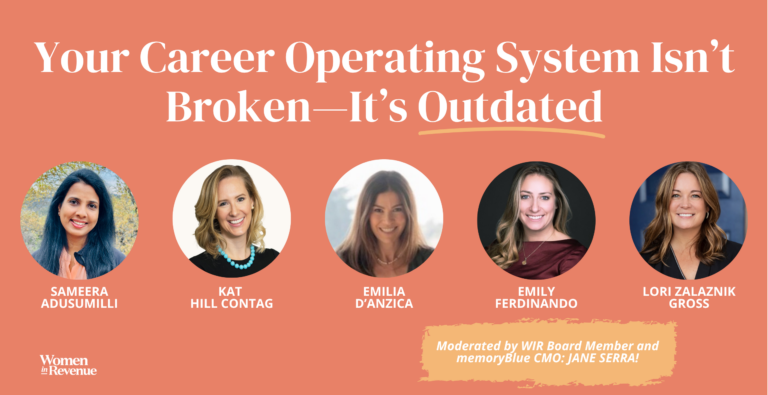
In the first episode of this mini-series, Lori Zalaznik Gross, provided guidance on how to shift the language you use to describe your work from effort to evidence.
For example, instead of saying:
“We onboarded 14 customers, ran 23 QBRs, and improved NPS by 6 points…”
Say:
“Customer Success protected $2.1M in ARR this quarter by accelerating onboarding velocity by 225% and identifying 8 at-risk accounts before churn.”
Same work. Different signals.
The second version invites a leader to lean in and ask, “Tell me more.”
[3] Choose the Right Audience
Visibility isn’t just about your direct manager.
You need to think beyond the room you’re in and identify:
- Your sponsor
- Your skip-level leader (with the proper transparency)
- A potential board or executive champion
These are the people making decisions about your next opportunity.
If they’re not seeing your work—or understanding its impact—you’re leaving your career progression up to chance.
Three Moves You Can Make This Week
Visibility is a skill. Like any skill, it improves with practice. I encourage all leaders I work with to start small.
[1] Map Your Influence
Identify the three people who will influence your next big opportunity.
Then ask:
- Are they seeing my work today?
- What do they believe about my impact?
If the answer is unclear, that’s your starting point.
[2] Reframe One Weekly Update
Take a regular update and remove the operational noise.
- Lead with numerical outcomes.
- Highlight business impact.
- Make it easy for someone to understand why it matters. (They can always ask for the “how” later.)
[3] Earn One Sponsor Conversation
Book 20 minutes with a skip-level leader or executive sponsor.
Not to give an update—but to ask: “What does a win look like for the next quarter?”
This question does two things: It aligns your work to what matters most—and it signals that you’re thinking at the next level.
Be Proud and Make It Known
One of the most important shifts I’ve made in my career is this: being proud of your work is not optional.
If you don’t communicate what you’re proud of, you’re asking others to guess. And in fast-moving organizations, they won’t.
Your work deserves to be seen. Your impact deserves to be understood. And your career deserves more than passive recognition.
Visibility is not about changing who you are. It’s about ensuring the value you create is impossible to ignore.
——————————–
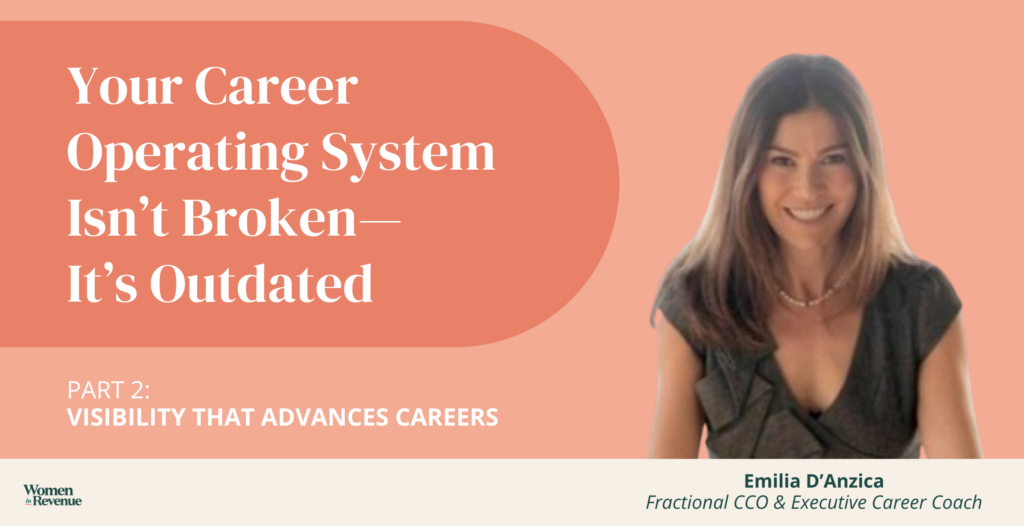
Emilia D’Anzica’s presentation on Visibility That Advances Careers, was part of the Women in Revenue members-only Mini-Series: Your Career Operating System Isn’t Broken—It’s Outdated.
Emilia D’Anzica has an accomplished 20-year Silicon Valley career, where she rose to Chief Customer Officer and go-to-market leader at companies including Jobvite, WalkMe, BrightEdge, Chorus, and Copper, building global teams and scaling revenue through customer-led growth. You can contact Emilia at Emilia@emiliadanzica.com.
To gain access to all Women in Revenue events and resources sign up to be a member here.